
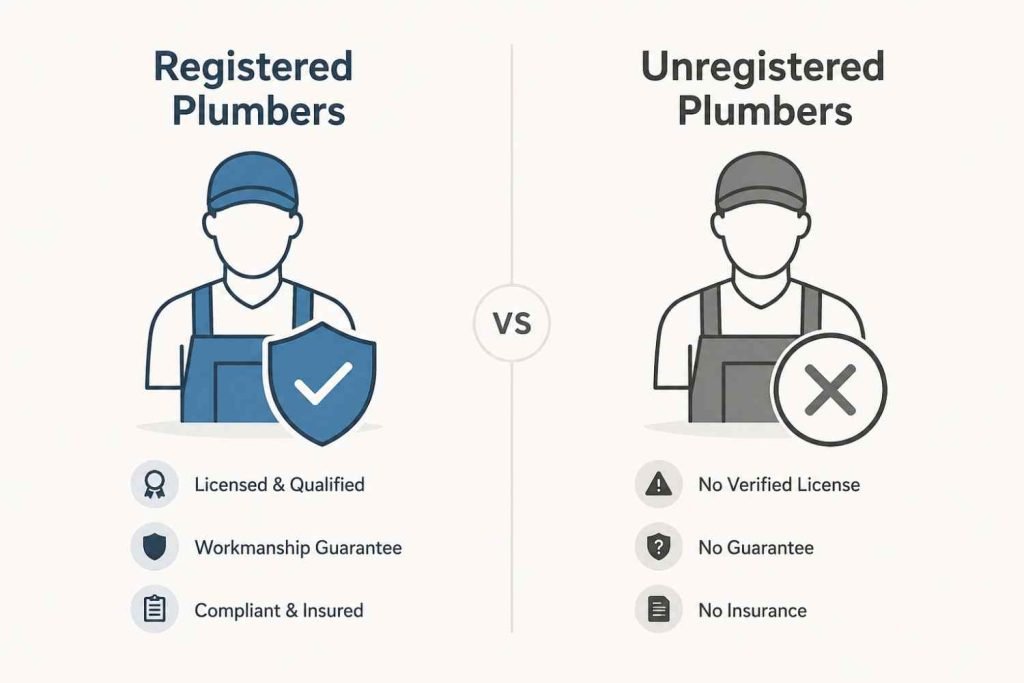
So you’ve got a leaking pipe or a boiler acting up, and you need a plumber fast. You search online, find someone cheap, and they’re available tomorrow. Sorted, right?
Not necessarily.
What most Dublin homeowners don’t realise until it’s too late is that hiring the wrong plumber can cost you far more than the original repair. We’re talking voided home insurance, problems selling your house, and in the worst cases, genuine safety risks.
Here’s what you actually need to know before you let anyone near your pipes.
The Two Types of Plumbers in Dublin
In Ireland, plumbers fall into a few different categories depending on the type of work they do and whether they’re registered with the right bodies.
For general plumbing work (fixing leaks, replacing taps, sorting radiators, bathroom installs), there’s no strict legal registration requirement. But that doesn’t mean “anyone will do.” A qualified plumber should have a recognised trade qualification such as a City and Guilds Level 2 or 3, or an equivalent Irish cert from SOLAS, and should carry public liability insurance.
For gas work (boiler servicing, gas appliance installation, connecting a gas hob), the rules are completely different and much stricter.
RGI: The One Registration That Actually Has Legal Weight
If your job involves anything to do with gas, your plumber must be registered with the RGII, the Registered Gas Installers of Ireland. This scheme operates under the supervision of the Commission for Regulation of Utilities (CRU), and it is a legal requirement, not a suggestion.
To become RGI registered, a plumber must complete approved training, pass technical assessments, and undergo regular audits. Every registered installer carries an ID card and a licence number that you can check yourself on rgi.ie.
This matters for several reasons that go beyond just the quality of the work.
What Actually Happens If You Hire an Unregistered Plumber for Gas Work
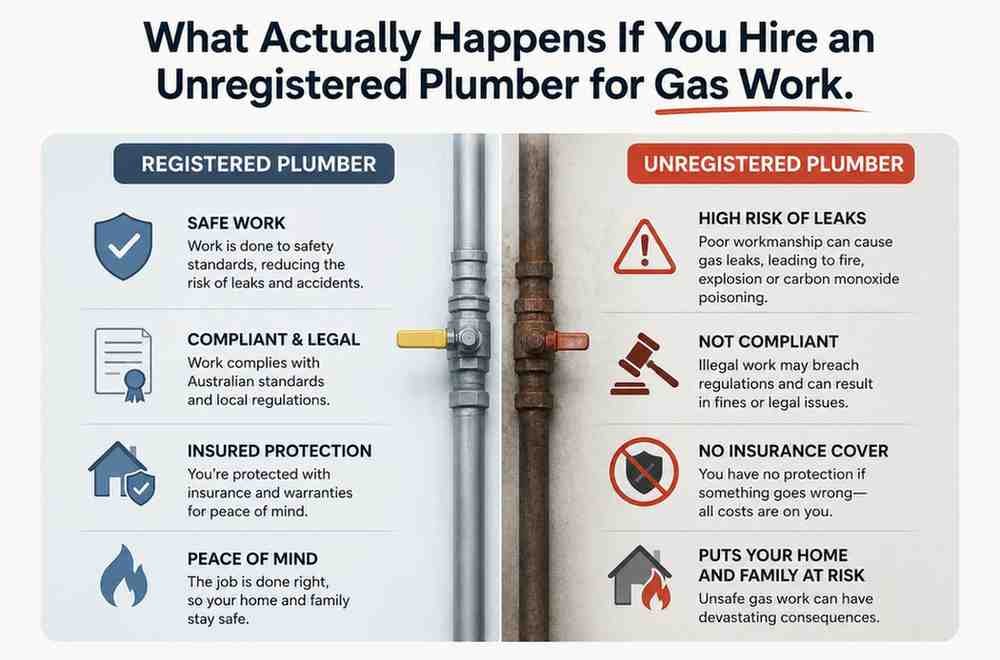
This is where a lot of people get a nasty surprise. It’s not just about shoddy workmanship. The consequences of using an unregistered person for gas work are serious.
It’s a criminal offence. In Ireland, it is illegal for an unregistered person to work on gas appliances. Full stop.
Your home insurance gets voided. Gas work carried out by someone without RGI registration typically invalidates your home insurance policy. So if something goes wrong after the job, whether it’s a leak, a fire, or carbon monoxide exposure, you could be on your own when you try to claim.
Your boiler warranty disappears. Most boiler manufacturers require that installation and servicing is done by a registered installer. Use an unregistered person and the warranty is gone.
It causes serious problems when you sell your house. If you’ve had gas work done without a Certificate of Completion from an RGI installer, it will show up during conveyancing. This can delay or even kill a property sale. Your solicitor will ask for these certificates, and if you can’t produce them, buyers get nervous.
Read More: 10 Best Budget Friendly Plumber Companies in Dublin
What About General Plumbing? Do I Still Need to Be Careful?
Yes, even for non-gas work, there’s a real difference between a qualified, insured plumber and someone who turns up with a wrench and no paperwork.
Any plumber working in your home should carry public liability insurance of at least €2.6 million. This protects you if something goes wrong during the job and your property is damaged. Always ask to see the certificate before work starts.
Call-out rates for a plumber in Dublin typically run from €60 to €120 per hour, and a standard call-out starts around €95. Emergency or after-hours work costs more. If someone is quoting you far below this, it’s worth asking why.
CIRI, the Construction Industry Register Ireland, is another register worth knowing about. It’s been voluntary since 2014 but is moving toward mandatory registration. Being on the CIRI register signals that a contractor meets defined standards around technical qualifications, workmanship, insurance, and financial standing. It’s essentially a quality mark.
The CIRI Shift: What’s Changing in 2026
Ireland’s construction industry is going through a significant change right now. CIRI is transitioning from a voluntary register to a mandatory one. Once mandatory registration applies to a specific category of work, contractors operating in that category must be registered to work legally.
For homeowners, this means the market is getting more regulated, which is good news. But it also means you should be asking contractors which registers they’re currently on, because in 2026 the landscape is shifting.
How to Check If Your Plumber Is Registered
It takes about 30 seconds. Here’s how:
For gas work: Go to rgi.ie and use the “Find an Installer” search tool. Type in the plumber’s name or business name. You’ll see their licence status, licence number, and expiry date. You can also check what type of work they’re authorised for, because not all RGI installers are cleared for all gas work categories.
If the person or company does not appear in the results, they are not legally permitted to work on gas systems in Ireland. Walk away.
For general plumbing: Ask for their CIRI registration number and check at ciri.ie. Also check that they’re a member of the Construction Industry Federation (CIF).
Ask these questions before hiring anyone:
- Are you RGI registered? (essential for gas work)
- Can I see your public liability insurance certificate?
- Will you provide a Certificate of Completion after the job?
- Are you on the CIRI register?
A reputable plumber will not hesitate on any of these. If someone gets defensive or vague, take that as a sign.
Plumbing Costs in Dublin: What’s Normal
Just so you have a reference point:
- Standard call-out fee: around €95 for normal hours
- Hourly rates: €60 to €120 depending on the job and the tradesperson
- Boiler replacement: €1,500 to €3,500 depending on the boiler type and access
- Full bathroom installation: €4,000 to €12,000 depending on spec
- Emergency or after-hours call-out: higher than standard rates
Dublin rates tend to run around 15 to 20 percent above the national average. If a quote seems significantly cheaper than these figures, it’s worth asking what’s been left out.
Always get a written quote that breaks down labour, parts, and VAT separately. A verbal quote is not a quote.
The Certificate of Completion: Don’t Skip This
After any notifiable gas work, your RGI installer is legally required to give you a Certificate of Completion (sometimes called a Gas Safety Certificate). This document confirms the work meets Irish gas safety regulations.
Keep it. You’ll need it for:
- Your home insurance records
- Any future property sale
- Mortgage drawdown paperwork
- Warranty claims on the boiler or appliance
Losing it or never receiving one in the first place creates headaches down the line. If a plumber does gas work and doesn’t mention a certificate, ask for it immediately.
Summary: The Quick Version
If you need to take away one thing from this article, it’s this: for gas work in Dublin, always use an RGI registered installer and verify it on rgi.ie before the job starts. For general plumbing, hire someone with public liability insurance and a proper trade qualification.
The few euros you might save by going with an unregistered tradesperson are not worth the risk of voided insurance, a failed property sale, or a safety issue in your home.
Dublin has over 1,375 listed plumbers across the city and surrounding suburbs including Finglas, Clontarf, Tallaght, Blanchardstown, Swords, Rathfarnham, and Dun Laoghaire. There’s no shortage of qualified, registered professionals to choose from.
Do five minutes of checking before you book. It’s worth it.
FAQ: Registered Plumbers in Dublin
Is it illegal to use an unregistered plumber in Dublin? For gas work, yes. It is a criminal offence for an unregistered person to carry out gas work in Ireland. For general plumbing, there’s no strict legal requirement, but using an unqualified or uninsured plumber puts you at financial and practical risk.
How do I check if a plumber is RGI registered? Visit rgi.ie and use the “Find an Installer” tool. Search by name or company. If they don’t appear, they’re not authorised to do gas work legally in Ireland.
Does using an unregistered plumber void my home insurance? For gas work, yes. Unregistered gas work typically voids your home insurance and your boiler warranty.
What is a Certificate of Completion and do I need one? Yes. After any notifiable gas work, your RGI installer must provide this certificate. You’ll need it for insurance records, property sales, and warranty purposes.
What’s the difference between RGI and CIRI? RGI (Registered Gas Installers of Ireland) is the legal requirement for gas work specifically. CIRI (Construction Industry Register Ireland) is a broader construction register that covers general building and plumbing contractors.
How much does a registered plumber cost in Dublin? Standard call-out rates typically start around €95. Hourly rates run from €60 to €120. Emergency or after-hours work costs more. Boiler replacement ranges from €1,500 to €3,500.
